What is the best fax service for law firms?
For most law firms, Fax.Plus is the best overall choice: the Business plan ($27.99/month billed annually) delivers 1,000 pages, ISO 27001 + SOC 2 and Swiss data protection, with Zapier connectors for Clio, PracticePanther and MyCase (the Fax API itself is Enterprise-tier). If your practice touches PHI (personal-injury, medical-malpractice, health-law), move up to the Enterprise plan ($79.99/month annual, 4,000+ pages), which is the only Fax.Plus tier that includes HIPAA with a signed BAA. For litigators who live in court and need the best mobile experience, iFax Plus ($24.99/month, 500 pages) or Pro ($33.33/month, 1,000 pages with SOC 2 + ISO 27001) is the better fit. Solo practitioners with low volume can start with CocoFax Lite at $4.99/month (annual).
Do law firms need encrypted fax services?
Yes. Law firms have a professional obligation to protect client confidentiality under ABA Model Rule 1.6. Sending unencrypted faxes containing privileged information — case documents, settlement offers, financial records, medical records in personal injury cases — creates both ethical and legal liability. Use a fax service with 256-bit TLS encryption in transit and AES-256 at rest.
Can attorneys fax from their phones?
Yes. iFax offers a highly rated mobile fax app for attorneys (4.6/5 on the US App Store) with built-in camera scanner and e-signature, ideal for faxing from courthouses, client meetings, and depositions. Fax.Plus also offers iOS and Android apps; CocoFax works in the phone's browser. Mobile fax is especially useful for solo practitioners, litigators, and criminal defense attorneys.
What features should law firms look for in a fax service?
Law firms should prioritize: encryption (256-bit TLS + AES-256), audit trails for records retention, e-signature for engagement letters and settlements, mobile access for attorneys in court, team management for multiple users, integration with practice management software (Clio, PracticePanther, MyCase), and international coverage for cross-border matters.
Can I integrate fax with my legal practice management software?
Yes. Fax.Plus integrates with Clio, PracticePanther, MyCase, and other legal platforms via Zapier (its Fax API is available on the Enterprise tier). Documo's REST API enables integration with document management systems like NetDocuments, iManage, and Worldox. SRFax provides API libraries for custom integrations with PCLaw and proprietary systems.
What is the cheapest fax service for solo attorneys?
CocoFax Lite at $4.99/month (annual billing) is the cheapest defensible option: encrypted faxing (256-bit AES, TLS in transit), published GDPR framework, 60 pages/month, unlimited secure storage, and a 30-day money-back guarantee. Practical caveats: CocoFax's compliance posture is self-attested, and the BAA is on request rather than automatic, so don't rely on the Lite plan when a file contains medical records. For attorneys who actually fax from court, iFax Plus at $24.99/month (500 pages, signed BAA, SOC 2) is usually better value because the mobile app, built-in e-signature and AI OCR save real time per matter.
Is fax more secure than email for legal documents?
Not more secure than encrypted email. An online fax service's encryption protects your upload and the copies on its servers, but the call to the recipient's machine is an ordinary fax, not encrypted from end to end, and a German data protection authority rates fax, for confidentiality, at the level of an unencrypted email. For the most sensitive documents, end-to-end encrypted email or a secure client portal protects the content better. Fax does have one practical advantage for legal use: the confirmation records that a fax machine at the number you dialed took the pages, and when. That's evidence of sending, not proof that anyone read the fax, and some courts that allow service by fax, such as California's, ask for the transmission report with the proof of service.
Do courts still accept faxed documents?
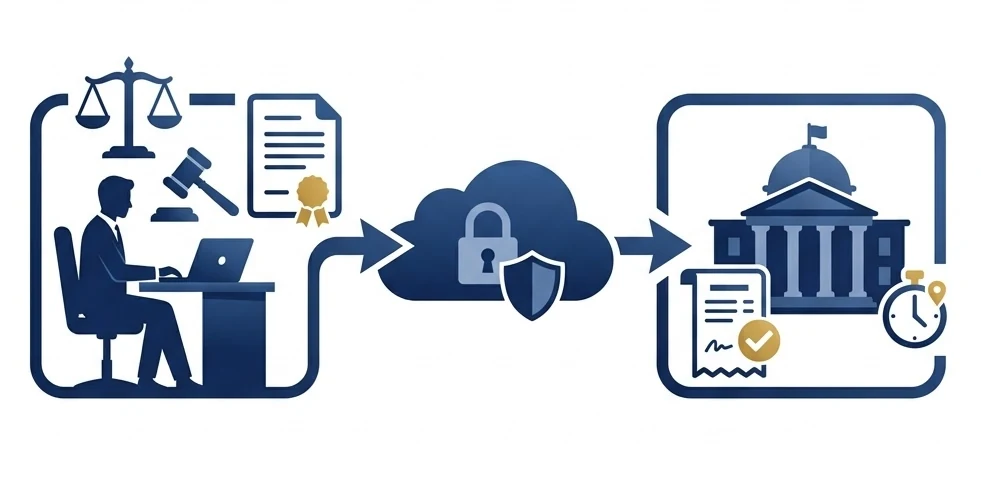
Some do, under their own rules. In federal court, a party with a lawyer must file electronically unless the court allows otherwise (FRCP 5(d)(3)(A)). State rules vary: California, for example, allows papers to be served by fax only when the parties agree, and the proof of service must attach the transmission report (California Rules of Court, rule 2.306). Check the court's rules and local rules before relying on fax for a filing or for service.

 Documo
 iFax
 eFax
 SRFax
 CocoFax